
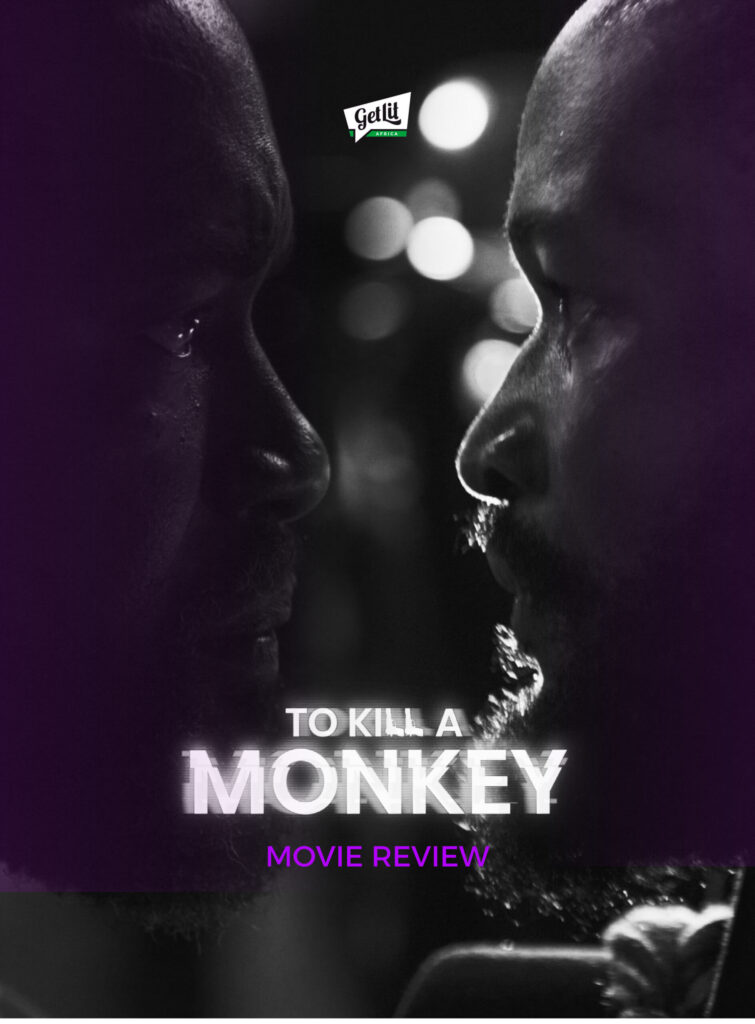
You know those movies you simply watch to keep your adrenaline pumping—where you’re at the edge of your seat, eyes glued to the screen, anticipating, itching for something that never quite becomes? Then, when it all ends, you sit in silence, unsure of what exactly you were looking for—that’s how I feel about To Kill a Monkey. It feels like an itch you can’t quite reach. But you overlook it, because the rush was simply ecstatic. The captivating dialogues, the compelling delivery of each character, and the exciting plot woven into an immaculate storyline carry you all the way through.
However, if you’re an avid movie enthusiast who longs for depth— poetic technicality portrayed by intricate storytelling and visual metaphors that linger in your mind—To Kill a Monkey may leave you wanting. It dances with the idea of complexity but doesn’t quite commit. It was as though there were hints of something more profound beneath the surface, but they were quickly buried under the pace and performance—especially towards the end, where all we got was a voiceover summary of a story we had been following from scene one, episode one, season one—come on!
We were essentially made to feel so many emotions and process them all while still trying to connect the dots just enough to make sense of the ending. The slow build of intrigue was suddenly reduced to a moment of “oh, okay” due to underwhelming plot twists that felt lazily thrown in at the end. In a bid to keep up the buzz and maintain the cinematic highs, significant moments that had the potential to complete the story and seal the plausibility of earlier events were lost along the way.
So, somewhere along the lines, at that point where the narration should have culminated in a sense of satisfaction—where everything falls together and lands both intellectually and emotionally—I just didn’t get there. Instead, everything began to happen all at once, leaving the story feeling rushed and unresolved—after dragging through the first few episodes.
Still, for what it is— as a gripping, emotionally charged, and fast-paced ending series, it delivers in its own way. It really depends on whether you’re in it for the thrill or in search of something more profound.
Now, on to a more pressing question that seems to be at the center of every conversation among those who have seen the movie. Team Efe or Team Oboz?
Honestly, I’m not quite sure why this has become such a hot topic of discussion. For me, the script simply failed to evoke any emotion compelling enough to make me feel deeply for either of the two main characters. I wasn’t moved, torn, or even mildly conflicted—just indifferent. But I’ll dive in a bit—for the fun of it.
Character Review: Efe
Efe—a tragic product of a nation that constantly fails its most promising minds. A first-class graduate with clear tech skills, a laptop, and access to WiFi—however stolen—shouldn’t have found himself grovelling for crumbs in a dingy restaurant.
Efe’s descent into fraud wasn’t immediate, but it was inevitable. He bore the weight of society’s expectations, economic hardship, and the haunting pressure of simply trying to survive. Efe didn’t just reflect the struggles of the average unemployed Nigerian man; he embodied the slow erosion of dignity that comes when a country fails to invest in its own future.
But then again, how plausible is it, really? That a tech-savvy graduate with such profound skills would be so helpless in the digital age—an age where remote gigs and side hustles have become lifelines? The script asks us to believe in the absolute desperation of Efe’s situation, yet his educational background and skill set introduces a subtle layer of contradiction, but to be fair, he probably just wasn’t a lucky individual—assuming that is what the script was trying to project.
Although you see Efe as a victim, you should also see him as someone who stopped trying to find a way out the moment he tasted power. The moment he chose to dance with the devil, there was no use pretending to be holy. Once he said yes to the game, there was no moral high ground to stand on—not even with a well-pressed suit, fresh clean haircut and a laptop in hand. Efe couldn’t play the saint while building mansions, buying companies, laundering money, wearing designers, and riding through town in luxury cars. Honestly, I’m not even calling him out for taking the offer, the guy went through too much; but there was no use acting innocent with raised shoulders. He wasn’t just an unwilling passenger—he became a driver in the chaos, fully complicit, if not in action, then in silence. I mean, the guy knew Oboz was dangerous. He knew the work was dangerous.
This is why he could never truly be a good partner to Oboz. Where Oboz embraced the game head-on—street-smart, ruthless, and unwavering—Efe hovered in the grey, constantly torn between guilt and greed. He cheated, he lost his connection to his home and family, and he buried his principles beneath the weight of dirty money. He knew exactly who Oboz was, what they were doing, and what it would cost them—but still, he never left. Not when the stakes rose high. Not even when the bodies dropped.
In truth, had Efe accepted the reality of his choices—his darkness, his ambition, his hunger—he might’ve been a far more powerful force. Perhaps he could’ve matched Oboz’s wavelength, rather than clash with it. Perhaps together, they could’ve taken down Teacher. But denial made him weak. The rift between him and Oboz was the beginning of the end.
Because the moment they stopped seeing eye to eye, the cracks began to show. Their foundation started to rot from within, and the people onto them could smell it. Their internal misalignment didn’t just cost them power—it cost them everything they had built—and the Monkey wasn’t so hard to kill anymore.
In the end, Efe wasn’t just a victim—he became a symbol of personal compromise, and a reflection of what happens when you join the game but refuse to play by its rules.
Character Review: Oboz
It was quite clear that Oboz was never the model child. From the start, he knew school was not for him and his rough educational background that was projected to have been followed with cult clashes, failure and violence probably only cemented his belief that his survival wasn’t going to come from a classroom.
But it’s hard—almost impossible—to feel pity for Oboz. Because he was, in many ways, part of the problem. He represents those yahoo boys—as they are popularly known—who dive into internet fraud, chasing millions and billions without ever lifting a finger in honest work. That urge—the hunger for sudden wealth without structure or ethics—isn’t just dangerous; it’s deeply chaotic. And it feeds the very dysfunction that keeps the country burning.
Still, for the sake of literature—sentiments aside—you have to admit: the man played his game well. He built an entire enterprise off yahoo. He was sharp, rugged, and when he brought Efe into the game, his empire expanded even more.
But Oboz’s own flaws were what started his decline.
He was hot-headed, impulsive, and wildly erratic. The more tension grew between him and Efe, the more unstable he became. And in that chaos, Oboz stopped thinking like a leader and started reacting like a wounded dog—quick to anger, slow to listen. He never truly saw Efe as an equal. That refusal to share control, to stop and think when needed, became the root of everything that fell apart.
But yet, Oboz was human—frustratingly. It was hard to ignore his love for Efe and his family. His loyalty was raw and rooted in brotherhood. But the truth is, his nature—the life he had lived and the choices he made was inseparable from his person.
By the time Oboz began to realize the true value of what he had with Efe—not just as a friend, but as a partner—it was too late. The damage had been done, and the walls had already cracked. Unfortunately, what could’ve been a powerful alliance was reduced to betrayal…and death.
So, you see… I wasn’t really moved to feel a thing for either of the characters.
Overview
Ultimately, while the show was great, it failed as a cybercrime thriller. Rather than delivering smart cyber moves or psychological warfare, the show just relied on chaotic gang violence and absurd twists that were so unnecessary—like a flesh-eating godfather or a perfectly preserved severed hand after an explosion? The series told very significant moments rather than show them and it was practically rushed through in the end. This is a very common pill the Nollywood industry has actively forced us to swallow overtime.
Honestly, characters like Efe, Teacher, and Ivie made too many irrational choices that truly disconnected the viewers from the journey in the story. Unnecessary violent scenes like torturing an old man for information? And why was Ivie so hell bent on Oboz’s matter? When it’s not jazz—someone who clearly had no feelings whatsoever for her. If Efe never planned to run away with Amanda, what was the point in telling her to pack up? When he could have as well just gone? Nosa started out as such a strong character but she was just lost somewhere in the plot? Then for a villain, Teacher’s death was not only random but completely underwhelming. Oh, then Ozzy boy, I genuinely assumed the script was cooking him up for something big, only for him to show up at the end—like a lost dog. Honestly, the plot holes and lingering questions are too many to ignore.
What I truly believe is that the show relied more on shock value, plot twists and cinematic highs than logical, theme-driven conflict. No climax. No resolution.